 PLAY NOW

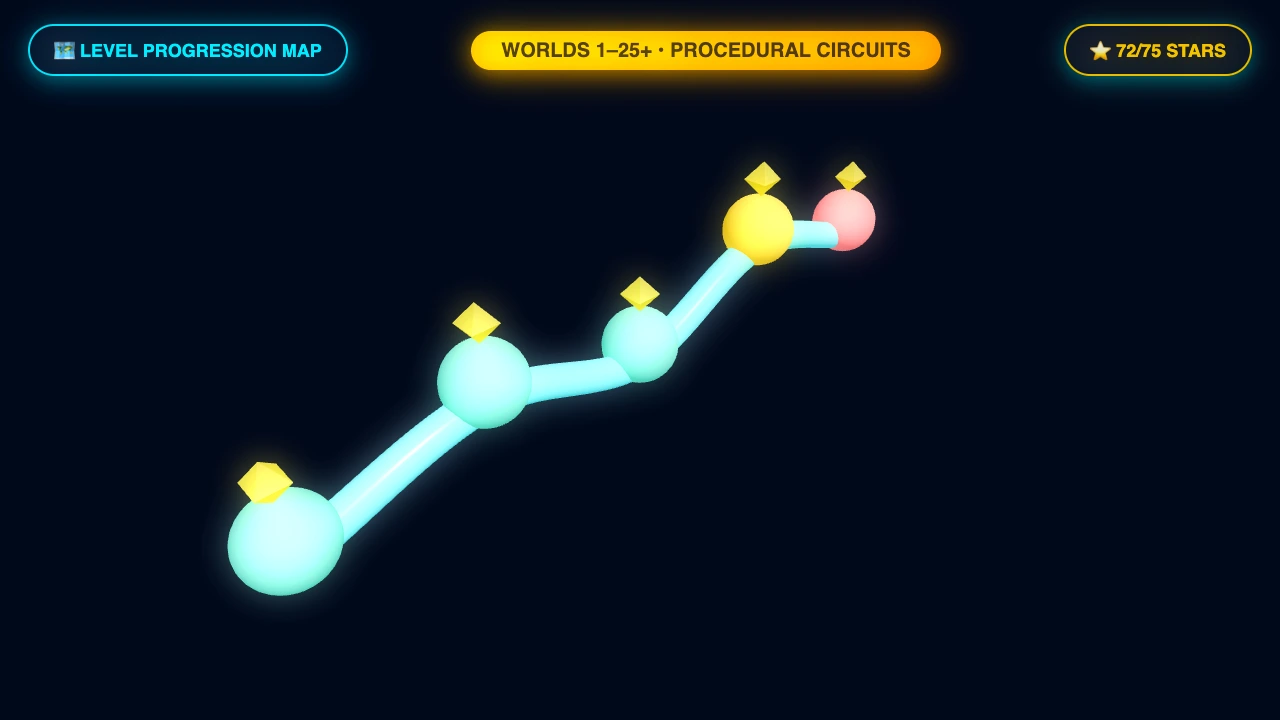
1. The Four Developmental Epochs of Swarm Leadership
- Epoch I: The Rookie Foundation (Levels 1–10):
Focuses on mastering instant math gate evaluation, establishing comfortable touch/mouse sensitivity, and completing initial starting crowd count upgrades. - Epoch II: Kinetic Hazard Mastery (Levels 11–25):
Focuses on spatial swarm compaction, learning the Pendulum Slip, dodging ground crushers, and eliminating centrifugal tail-whip casualties. - Epoch III: Tactical Boss Warfare (Levels 26–40):
Focuses on ranged boss DPS scaling, preserving swarm numbers for the Rainbow Staircase, and unlocking rare biome skins. - Epoch IV: Endgame Apex Optimization (Levels 41–50+ & Endless Gauntlet):
Focuses on micro-strafing racing lines, summiting the 10.0× Golden Apex consistently, and conquering global speedrunning leaderboards.
2. Epoch I (Levels 1–10): Arithmetic Reflexes & The 25-Runner Threshold
The Cardinal Rule: Multiplier Stacking vs Flat Additions
The single most common mistake rookie players make is instinctively picking large flat additions (such as +25) over modest multipliers (such as ×2). As established in our game design research, the mathematical inflection point occurs at exactly $N^* = 25\text{ runners}$:
- If your current swarm has under 25 runners, always prioritize flat additions (
+20or+30). At $N = 10$, a+20gate yields 30 runners, whereas a×2gate yields only 20 runners. - The instant your swarm reaches 25 or more runners, immediately switch to multiplier gates. At $N = 50$, a
×2gate produces $+50$ net runners, easily outpacing any flat addition on the board.
Early Capital Allocation
Do not spend your early coin earnings on cosmetic skins. Funnel 100% of your first 15,000 coins into Starting Swarm Count. Upgrading from 1 runner to 10 runners at spawn ensures that you hit the 25-runner multiplier threshold at the very first gate pair of every stage.
3. Epoch II (Levels 11–25): Hazard Defense & The Geometry of Flow
Eliminating the Tail-Whip Syndrome
When you swipe aggressively from the left lane to the right lane, trailing runners lag behind by approximately 350 milliseconds. To prevent your outer flank from dragging across centerline buzzsaws, master the Two-Stage Steering Cadence:
- The Early Angle (40 meters out): Initiate a smooth, shallow diagonal drift toward the clear corridor. This aligns your swarm longitudinally before the hazard threshold.
- The Neutral Drift (Passing Hazard): As your lead runner passes the hazard gantry, release lateral input entirely. Centripetal swarm cohesion will pull your trailing wings inward, narrowing your formation by up to 60%.
The Crusher Buffer Rule
On Magma Foundry tracks (Levels 21–25), never wait for a hydraulic crusher to fully retract into the ceiling before sprinting forward. As soon as the steel block slams the ground, dash into its lane; by the time your crowd reaches its front bumper, the block has already risen above character head height ($y > 1.8\text{ units}$).
4. Epoch III (Levels 26–40): Boss Destruction & Staircase Wealth
The Standoff Protocol
The biggest barrier to late-game coin wealth is boss collision attrition. Many players defeat the boss by physically ramming their swarm into the colossus, sacrificing 200 to 300 runners in a split-second melee trade.
In Epoch III, you must transition entirely to Ranged Standoff Combat:
- Circle the outer perimeter of the boss arena ($x = \pm 3.5$).
- Rely on your swarm's automatic energy bolts (firing at 5.0 Hz per runner) to whittle down boss health while maintaining a safe 10-meter standoff distance.
- By avoiding direct melee collisions, you preserve 95% of your crowd, entering the Rainbow Staircase with 400+ runners and locking in lucrative $5.0\times$ to $8.0\times$ multipliers.
5. Epoch IV (Levels 41–50+): Endgame Mastery & The 10.0x Apex Club
The Golden Apex Ascent (785 Runners Required)
Reaching Step 10 ($10.0\times$ Apex) requires crossing the finish line with exactly 785 surviving runners. This demands absolute tactical perfection across every stage component:
- Starting Headcount: Maxed starting swarm upgrade ($N_0 = 25$).
- Optimal Gate Multipliers: Catching at least three consecutive multiplier gates without touching negative portals.
- Zero Hazard Losses: Perfect execution of the Pendulum Slip and curb-riding buffer maneuvers.
- Flawless Boss Phase: Defeating the Cosmic Overlord with zero melee casualties.
Summiting the 10.0× Apex awards an instantaneous 1,000-coin completion bonus and triggers the golden victory confetti shower, marking your transition into an elite Swarm Titan.
6. The Master Upgrade Priority Matrix: Maximizing Every Gold Coin
7. Five Common Pitfalls That Destroy High-Level Runs
- Greed Divergence (Chasing Isolated Coins): Swerving across three lanes to grab a 10-coin cluster, only to arrive off-center at an approaching
×3gate and lose 100 potential runners. Remember: Surviving runners at the staircase generate far more coins than roadside pickups. - Hesitation in Dual Pinch Hazards: Attempting to 'brake' or slow down. Forward runner velocity is constant ($v_z = 28.0\text{ units/sec}$); hesitating only causes your crowd to fan out horizontally, expanding your collision footprint.
- Ignoring Biome Friction Transitions: Failing to apply counter-steering on the sub-zero ice of Biome 5, leading to unstoppable drift into track edges.
- Melee Panic in Boss Encounters: Colliding head-on with a boss when its health bar drops below 20%, throwing away 150 valuable runners right before the staircase climb.
- Neglecting Daily Challenges: Skipping the daily procedural gauntlet, which offers 3× coin bounties and unique cosmetic unlock badges.
8. Daily Training Routine: The 15-Minute Mastery Workout
- Minutes 0–5 (Warm-Up & Gate Precision): Run Levels 1 through 5 with zero hazard casualties. Focus on clipping the inner collars of every positive gate.
- Minutes 5–10 (High-Speed Hazard Drill): Run Level 25 (Magma Foundry) or Level 35 (Arctic Glade). Practice the Pendulum Slip and Crusher Sprint under pressure.
- Minutes 10–15 (The Apex Challenge): Attempt one continuous run through Level 50 or Endless Gauntlet Mode, aiming for at least one Step 10 Golden Rainbow Apex summit.
Consistent execution of this routine builds the subconscious muscle memory and rapid pattern recognition necessary to claim your rightful place among the elite Swarm Titans of Control Guys Count.
9. Cognitive Load & Decision Latency: The Neuroscience of High-Speed Play
The Three Sensory Stages
- Visual Saccade (0–120ms): The eyes scan the two gate placards, transmitting raw photon data to the visual cortex.
- Cognitive Arithmetic Evaluation (120–280ms): The brain compares the two numbers (e.g., $+20$ vs $\times 2$). If the player has not internalised the $N^* = 25$ threshold, this stage can stall for an additional 200ms, pushing the player past the decision window.
- Motor Cortex Command (280–420ms): The motor cortex signals the thumb or wrist to execute a lateral swipe.
By automating your response via the $N^* = 25$ rule (Under 25: pick plus; Over 25: pick times), you eliminate Stage 2 cognitive arithmetic entirely, converting the choice into an instantaneous spinal reflex that executes in under 180 milliseconds.
10. Comprehensive Progression Ledger (Levels 1–50 Milestones)
11. Mental Stamina & Flow State: The Psychology of Marathon Runs
The Saccadic Reset Technique
Because your eyes are locked in a continuous high-frequency visual scanning loop—alternating between gate numerals, approaching pendulum blades, and crowd boundaries—ocular muscle fatigue can introduce a 30ms to 50ms processing lag. To reset visual sharpness:
- Take a 2-minute break every 10 levels. Shift your gaze to a distant object across the room to relax your ciliary eye muscles.
- Avoid playing with high screen glare or in total darkness. Ambient room lighting that matches screen luminance reduces pupil strain and preserves peripheral reaction speed.
- If you suffer a catastrophic wipeout on a late-stage hazard, resist the urge to immediately rage-restart. Take three slow deep breaths to lower your heart rate back into the optimal cognitive zone (–75 ext{ BPM}$), where arithmetic pattern recognition operates with maximum clarity.