 PLAY NOW

The Definitive Player Manual: Mechanics, Physics & Crowd Dynamics
A comprehensive breakdown of forward auto-run momentum, lateral steering smoothing, spatial flocking algorithms, and collision hull dynamics in Control Guys Count.
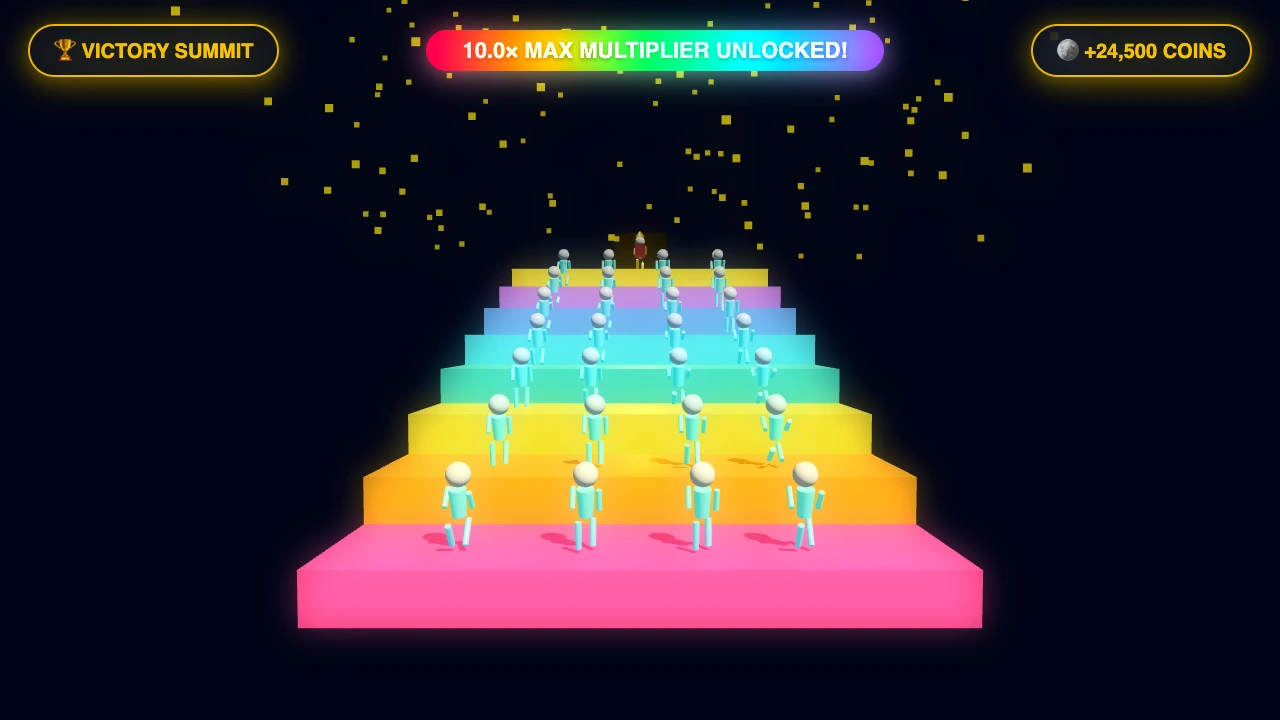
Welcome to the definitive gameplay manual for Control Guys Count. While the game presents an instantly intuitive pick-up-and-play arcade exterior, beneath the surface operates an intricate physical and mathematical simulation. Every stride, steering maneuver, crowd dispersion, gate contact, and combat clash is governed by deterministic rules designed to reward sharp reflexes, spatial awareness, and instantaneous mathematical reasoning. This manual provides players, competitive runners, and game enthusiasts with a microscopic breakdown of every underlying system driving your stick-figure swarm from the starting line to the pinnacle of the victory staircase.
1.1 Locomotion, Momentum and Lateral Inertia
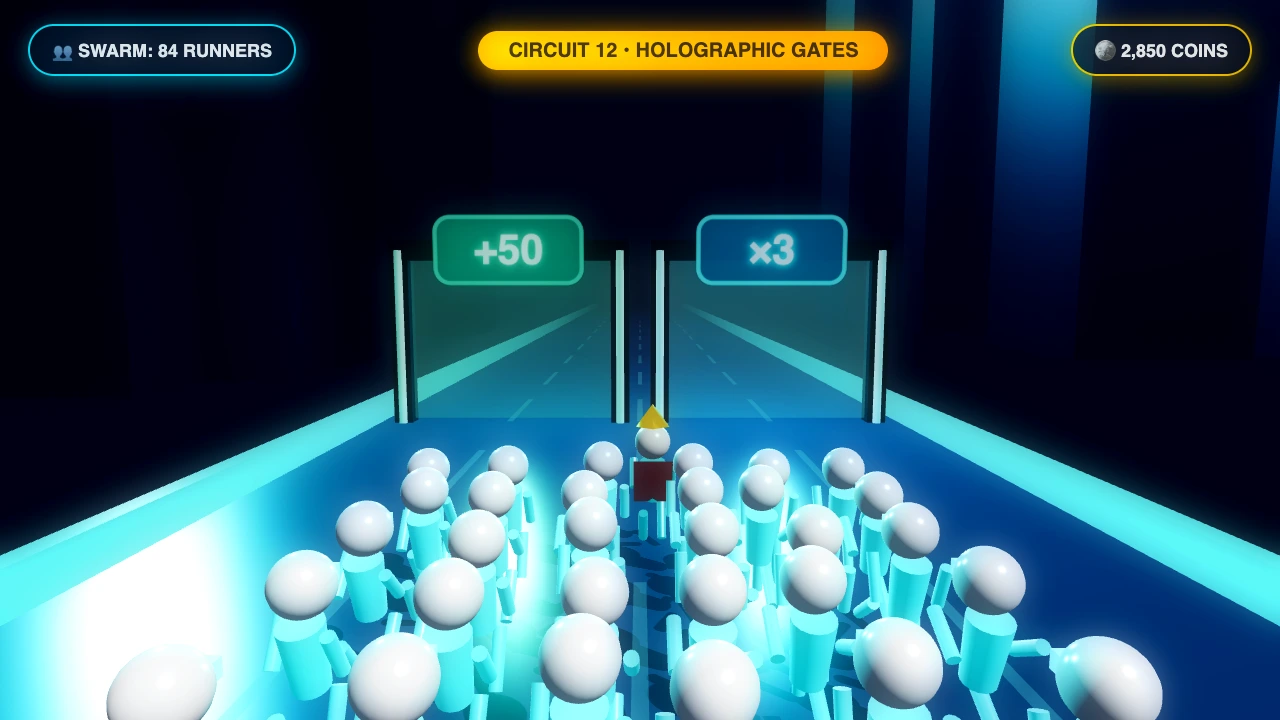
Unlike traditional endless runners where character movement is restricted to rigid discrete lanes (e.g., snapping abruptly between left, center, and right tracks; see our detailed physics comparison against Count Masters), Control Guys Count employs a continuous, fluid lateral coordinate space. The playable runner highway spans a width of exactly 16 world units, extending from lateral boundary coordinate X = -7.5 on the far left to X = +7.5 on the far right. The extra 0.5 units on each outer flank accommodate the physical thickness of the glowing guardrails, preventing character models from visually clipping through boundaries during extreme cornering maneuvers.
Locomotion operates on an automated forward velocity vector coupled with an analog lateral response system. At Level 1, your crowd advances down the track at a baseline speed of 26 world units per second. To maintain a progressive difficulty curve that naturally tests player reaction thresholds as you advance, the game engine incorporates a deterministic velocity ramp configured at exactly +0.8 units per second for each completed level. By the time a runner navigates through Level 10, the forward velocity reaches 33.2 units per second; by Level 25, velocity surges past 45 units per second. This progressive acceleration shortens the available visual preview window between upcoming hazards and gate arches from an initial 2,200 milliseconds down to sub-800 milliseconds, demanding instinctual steering inputs.
Lateral steering is governed by an exponential linear interpolation (lerp) smoothing function configured with a smoothing factor of lateralSmoothing = 0.18. When you initiate a lateral drag gesture via mouse cursor, capacitive touchscreen, or directional keyboard key (A/D or Left/Right arrows), the input does not instantaneously teleport the crowd centroid. Instead, the crowd accelerates toward your target X-coordinate with approximately 90 milliseconds of smoothing lag. This deliberate physical inertia gives your stick-figure crowd a sense of tangible weight and momentum. Mastering high-speed gameplay requires learning to initiate lateral steering inputs slightly before reaching obstacle thresholds, anticipating the gentle inertia curve of your crowd (explored extensively in our sub-16ms mobile touch latency framework).
1.2 Swarm Physics and Dynamic Centroid Allocation
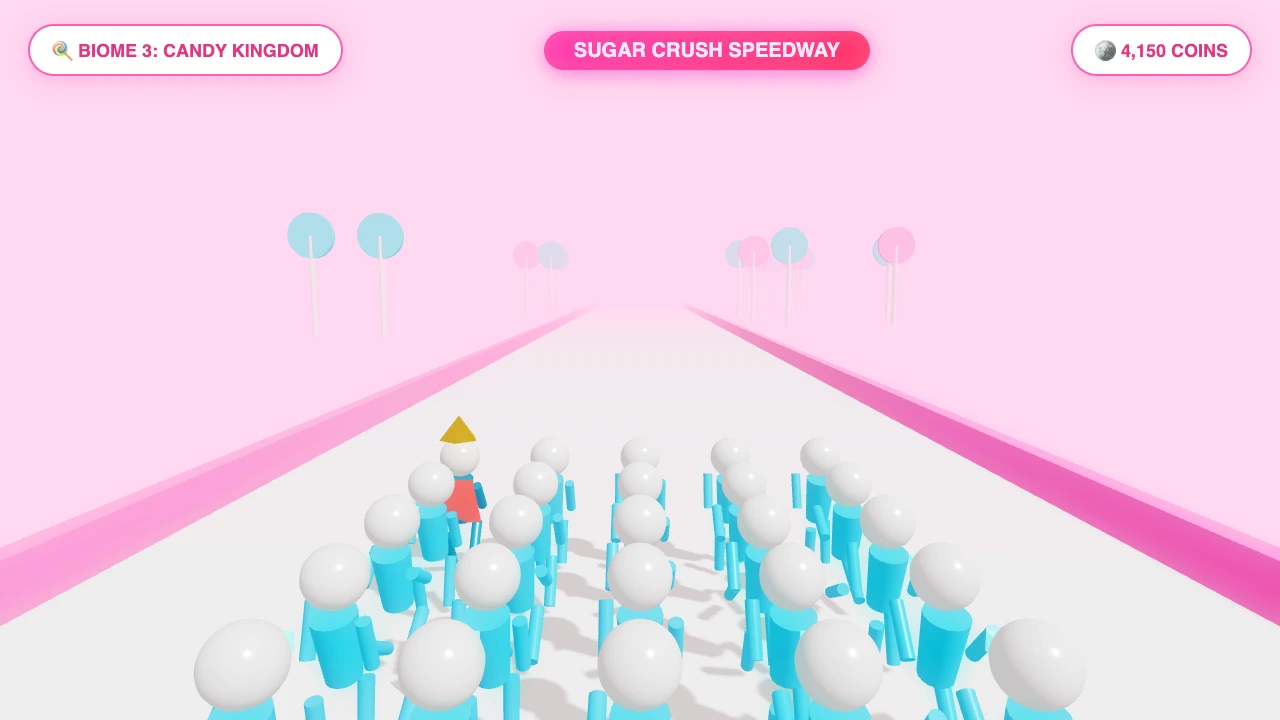
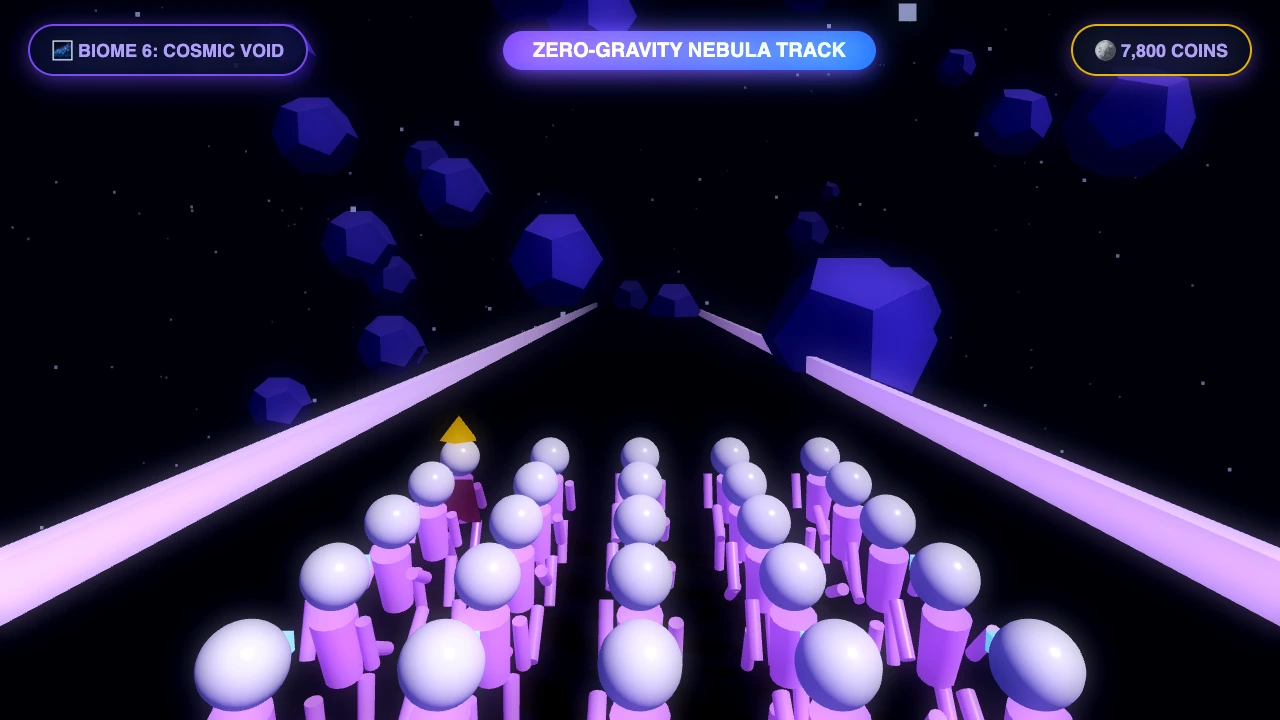
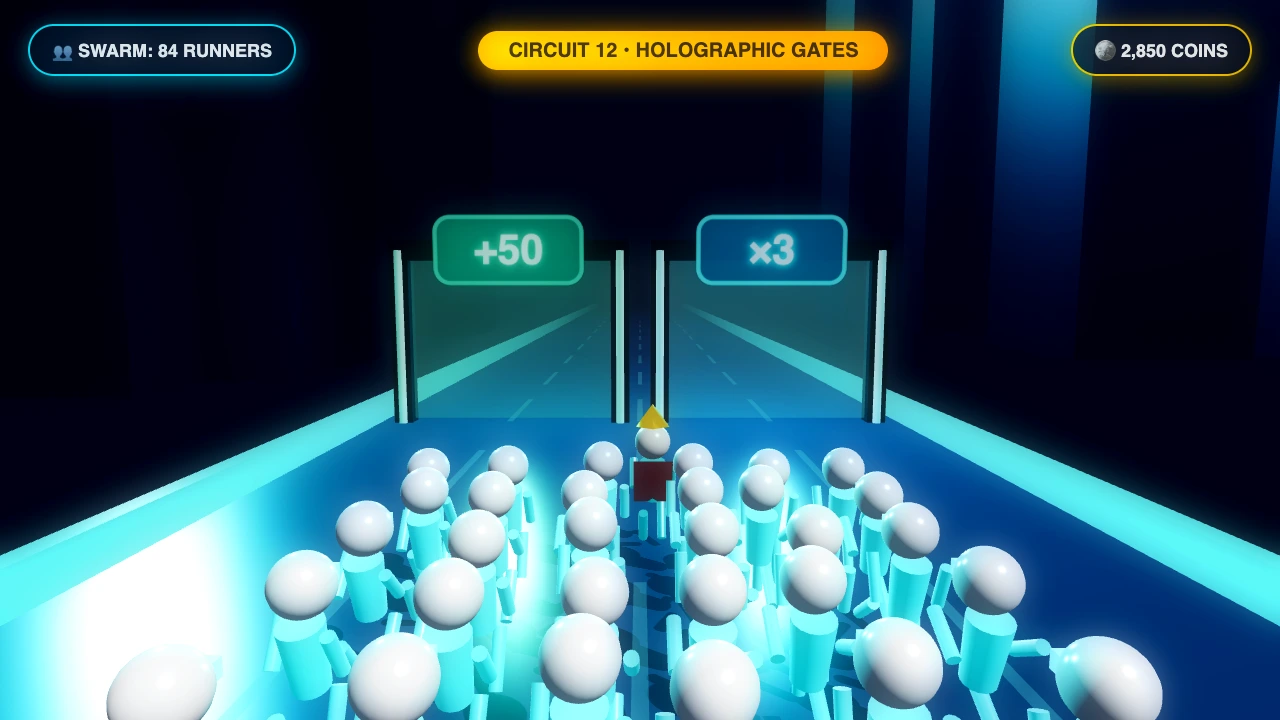
Managing hundreds of independent 3D characters in real-time requires a sophisticated flocking and spatial distribution algorithm. In Control Guys Count, individual crowd members are not rigid satellites glued to a central anchor; rather, they form an organic, cohesive swarm that dynamically contracts, expands, elongates, and reforms based on crowd size, lateral velocity, and road topography.
The crowd is anchored by a mathematical point known as the Crowd Centroid (C_x, C_z). Every member of your crowd is assigned a relative local coordinate offset (Δx_i, Δz_i) calculated using Fermat's spiral dispersion formula modulated by a lateral compression factor:
Δx_i = r_i · cos(θ_i) · W_compression, Δz_i = r_i · sin(θ_i) · L_stretch
When your crowd is small (1 to 15 members), characters cluster tightly around the crowned leader in a compact circular formation with a radius of less than 1.5 units. As math gates multiply your numbers into the dozens and hundreds, the formation organically stretches along the Z-axis (forward-backward) more than the X-axis (lateral). This deliberate elliptical elongation prevents large swarms from spilling over the outer guardrails or uncontrollably clipping both left and right math gates simultaneously.
Furthermore, when you execute rapid lateral maneuvers, a turn-banking lean angle (aLean) is injected directly into each character's GPU vertex transform. Characters tilt up to 15 degrees inward toward the direction of the turn, with outer flankers leaning deeper into the curve than inner members. This dynamic banking creates an exhilarating visual cascade reminiscent of a flock of birds or a high-speed motorcycle convoy banking through a velodrome.
Dynamic Flocking
Fermat spiral positioning with golden angle offsets ensures optimal spatial distribution, eliminating unsightly visual overlaps while maintaining tight pack cohesion.

Turn-Banking Lean
Characters automatically bank and lean up to 15° into lateral swerves via instanced vertex shader transforms, visually communicating steering inertia and speed.

Pooled Ragdolls
Eliminated members trigger instant physics impulses with upward launch trajectories, tumbling rotations, and opacity decays, providing instant tactile feedback.

1.3 Spatial Hash Collision Detection and Hitbox Geometry
In a hypercasual runner where crowd sizes frequently exceed 400 individuals and dozens of dynamic hazards oscillate simultaneously across the track, calculating naive $O(N \times M)$ bounding-box intersection tests every 16.6 milliseconds would devastate CPU performance and introduce noticeable micro-stuttering. Control Guys Count circumvents this bottleneck through a high-performance 1D Spatial Hash Grid combined with hierarchical bounding cylinders (read the full technical breakdown in our spatial hash grid collision detection guide).
The running highway is divided into longitudinal Z-axis buckets measuring exactly 10 world units in depth. Entities—including Math Gate arches, kinetic saw blades, swinging pendulums, enemy squads, and the boss titan—are registered into these buckets upon procedural generation. The engine's collision pipeline performs broadphase culling, completely ignoring any entity situated further than 15 units ahead of or 5 units behind the crowd centroid.
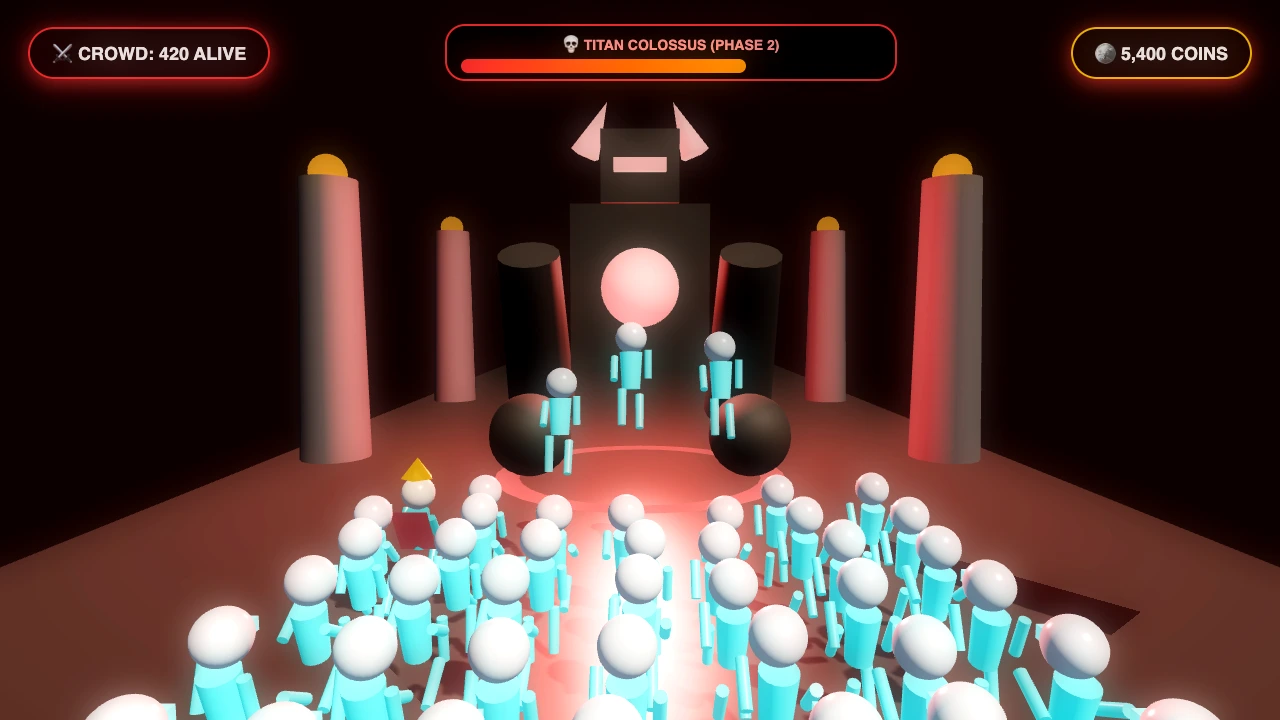
During the narrowphase evaluation, individual character hitboxes are treated as lightweight vertical cylinders with radius R = 0.32 units and height H = 1.6 units. When an obstacle's danger volume intersects a character's cylinder, that specific character is immediately tagged for elimination. Rather than destroying the Three.js mesh instance, the character is instantly detached from the active swarm pool and spawned into a recycled ragdoll particle pool. The ragdoll receives an impulse vector directed upward and backward (V_y = +6.0, V_z = -8.0), cartwheeling through the air with angular momentum while rapidly fading to transparency over 650 milliseconds.
1.5 Camera Tracking, Procedural Sway and 3D Trauma Screen Shake
Camera feel is the soul of any compelling 3D runner. In Control Guys Count, the camera does not sit on a rigid mathematical tripod. Instead, it operates on a sophisticated dual-layer chase algorithm combining exponential smoothing (cameraFollowSmoothing = 0.15) with procedural sinusoidal sway and physics-based 3D trauma screen shake.
As your crowd surges down the track, the camera executes a gentle figure-eight orbital bobbing motion synchronized directly to your crowd's forward running velocity. When running at the baseline speed of 26 units per second, the camera oscillates with a frequency of f = 2.4 Hz and an amplitude of 0.08 units along the Y-axis and 0.04 units along the X-axis. This subtle breathing motion simulates the organic viewpoint of an aerial chase drone tracking an athletic sprint, preventing visual stagnation during straight track sections.
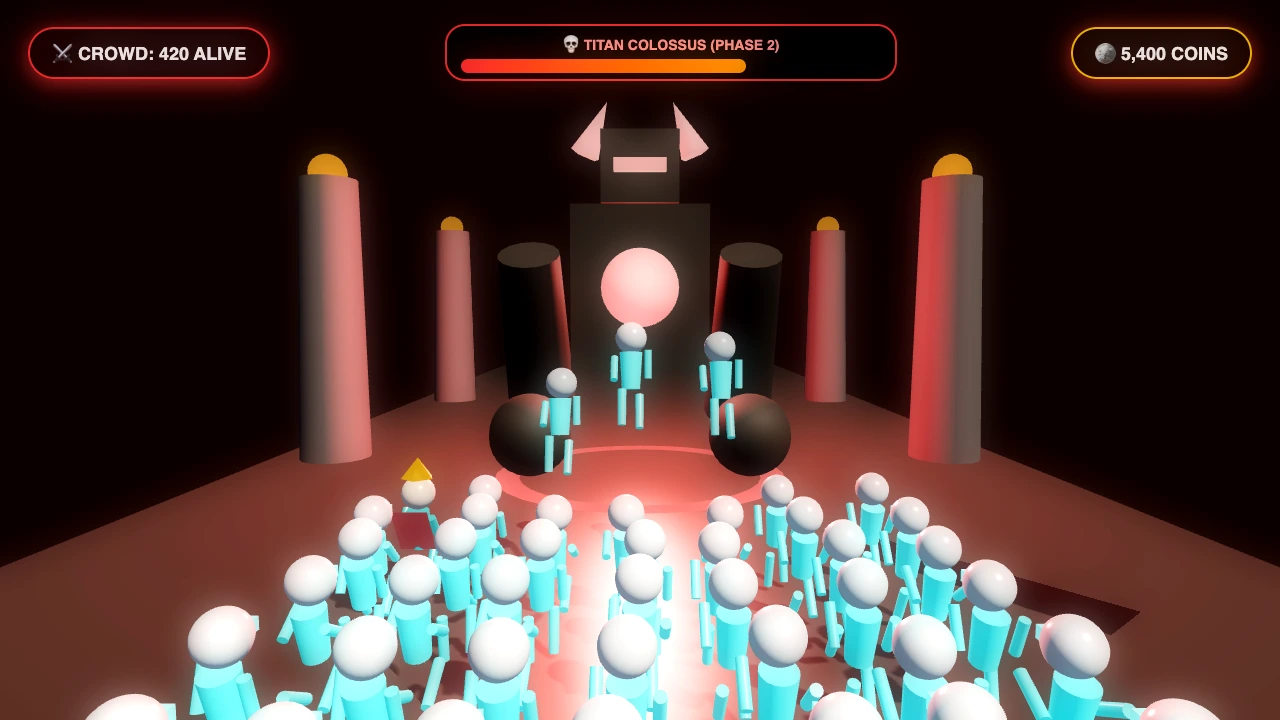
When impacts occur—such as colliding with a static concrete barricade, clashing with an enemy squad, or absorbing a ground slam from the Titan Golem—the engine does not employ simplistic linear camera jitter. Instead, it implements a genuine Trauma-Based Non-Linear Screen Shake System. Screen trauma is tracked as a floating-point scalar variable T ∈ [0.0, 1.0].
Displacement = Max_Offset · (Trauma)^2 · Perlin_Noise(t · Shake_Frequency)
Angle_Roll = Max_Roll · (Trauma)^2 · Perlin_Noise(t · Shake_Frequency + 100)
Notice that camera displacement and rotational roll are proportional to the square of trauma (T^2). This quadratic scaling ensures that minor impacts (such as grazing a road bump or losing a single flanker) create subtle, satisfying tactile thuds, while catastrophic impacts (such as suffering a direct hit from a boss war club) produce violent, disorienting screen shudders that convey immense physical force without causing motion sickness. Trauma decays exponentially at a rate of 1.4 units per second, returning the camera to smooth cinematic pursuit within 700 milliseconds.
1.6 Staggered Gate Hop Ripple Waves and Spawn Transitions
One of the defining visual signatures of Control Guys Count is the Gate Hop Wave. When your crowd passes through a positive math gate, the characters do not passively increment an odometer; rather, a joyous, kinetic ripple wave propagates across the entire swarm.
The ripple wave is calculated using a spatial propagation function based on each character's longitudinal rank distance from the gate threshold. Characters in the front rank initiate a vertical hop (Δy = 1.2 units) immediately upon crossing the gate plane (t = 0). Members in rank 2 hop 15 milliseconds later; members in rank 3 hop 30 milliseconds later, and so forth, creating an undulating wave of motion that travels from front to back through hundreds of runners.
Simultaneously, newly generated runners created by multiplication gates do not abruptly pop into existence at full scale. Instead, they spawn via a 250-millisecond Squash-and-Stretch Pop-in Transition driven by the vertex shader attribute aSpawnTime:
New runners burst from the holographic gate curtain at scale 0.0, overshoot elastically to scale 1.25 with an energetic vertical bounce, and settle cleanly to standard scale 1.0. This dynamic visual feedback makes multiplying your crowd from 20 to 100 feel like an explosive, celebratory fireworks display.
1.4 Complete Controls Reference and Input Mapping
Control Guys Count is built on a unified cross-platform input abstraction layer. Whether you are playing on a dual-monitor desktop workstation with a high-polling gaming mouse, a laptop with a trackpad, a smartphone with capacitive multi-touch, or a tablet with an active stylus, the steering response remains identical.
| Input Method | Primary Action | Secondary Action | Pause / Menu | Dev Overlay |
|---|---|---|---|---|
| Touchscreen (Mobile/Tablet) | Horizontal touch drag (1:1 finger tracking) | Double-tap to quick-restart | Pause button on top-left HUD | Three-finger tap gesture |
| Mouse (Desktop/Laptop) | Left-click hold + horizontal drag | Click & drag anywhere on canvas | Escape (Esc) or Spacebar | Tilde key (~) or ?debug=1 |
| Keyboard (Standard) | A / D keys or Left / Right arrows | Hold Shift for precision micro-stepping | Escape (Esc) or P key | Backquote / Tilde (~) |
| Gamepad / Controller | Left Analog Stick (horizontal axis) | D-Pad Left / Right buttons | Start / Menu / Options button | Select / Back button |