
 PLAY NOW

1. The Physics of Track Materials: Friction, Drag & Swarm Cohesion
- $F_{steer}$: The lateral force applied by the player's mouse, keyboard, or touchscreen drag.
- $\mu_{track}$: The surface friction coefficient, ranging from $\mu = 0.15$ (icy Arctic Glade) up to $\mu = 0.95$ (viscous Candy Kingdom).
- $N_{ground}$: Normal ground reaction force, which varies dynamically during vertical elevation ramps.
- $C_{drag}$: Atmospheric aerodynamic drag, which drops to zero in the vacuum of space.
When transitioning between biomes, players who fail to adapt their steering cadence will either oversteer violently into track curbs or understeer directly into oscillating buzzsaws. Mastering biome-specific handling is the hallmark of a true grandmaster.
2. Biome 1: Urban Asphalt & Concrete Metropolis (The Training Baseline)
- Friction Coefficient: $\mu = 0.60$ (Balanced road asphalt). Lateral steering inputs produce immediate, linear response with predictable 80ms damping.
- Visual Lighting: Directional sunlight at a 45-degree angle with soft ambient occlusion shadows. Contrast ratio against standard Cyan runners is a crisp 7.2:1.
- Atmospheric Particles: Low-density urban dust motes ($N = 120$ particles) with zero performance impact on budget GPUs.
- Primary Hazard Rhythm: Simple harmonic pendulums and static centerline buzzsaws with generous 3.0-second periods.
Biome 1 is designed to instill confidence and teach basic math gate evaluation. The asphalt provides sufficient grip that sudden evasive swipes do not cause severe centrifugal tail-whip, allowing new players to focus entirely on cognitive arithmetic.
3. Biome 2: Neon Highway (Cyberpunk High-Speed Grid)
- Friction Coefficient: $\mu = 0.52$ (Slightly slick synthetic composite). Runners carry slightly more lateral inertia through turns, requiring pre-steering inputs 100 milliseconds earlier than in Biome 1.
- Visual Lighting & Shaders: High-contrast nocturnal palette dominated by electric cyan and hot magenta neon light sources. Real-time planar reflections on the wet asphalt surface create striking visual depth.
- Contrast Challenges: The dark asphalt can obscure low-saturation runner skins. Equipping Cyber Neon, Golden King, or Crimson Blaze is strongly recommended to maintain peripheral awareness of crowd boundaries.
- Kinetic Hazard Upgrades: Introduces high-speed oscillating saws that traverse the track at $4.5\text{ units/sec}$, along with flickering holographic math gates that periodically shift numerical values.
4. Biome 3: Magma Foundry (Industrial Heat & Hydraulic Hazard Gauntlets)
- Friction Coefficient: $\mu = 0.45$ on perforated steel catwalks, with localized zones of hot oil slicks where $\mu$ drops precipitously to $0.22$.
- Thermal Heat Distortion: Screen-space fragment shader ripples simulate intense rising heat waves above lava trenches. This visual refraction subtly distorts the apparent position of hazard hitboxes 30 meters ahead.
- Atmospheric Particles: Heavy floating cinder sparks and embers ($N = 450$ instanced billboard quads) swirling dynamically via a 3D simplex noise vector field.
- Signature Hazard: Hydraulic Slam Crushers. Massive multi-ton steel pistons that strike the runway with ground-shaking shockwaves, forcing players to time their movements around 650ms ground dwell states.
Pro Tactical Tip: On steel grate catwalks, the low friction amplifies swarm spreading. To prevent your outer runners from spilling over the rail-less edges into molten lava, avoid continuous lateral holds. Instead, use 'tap-feathering' (rapid discrete taps) to adjust position while keeping the swarm compacted.
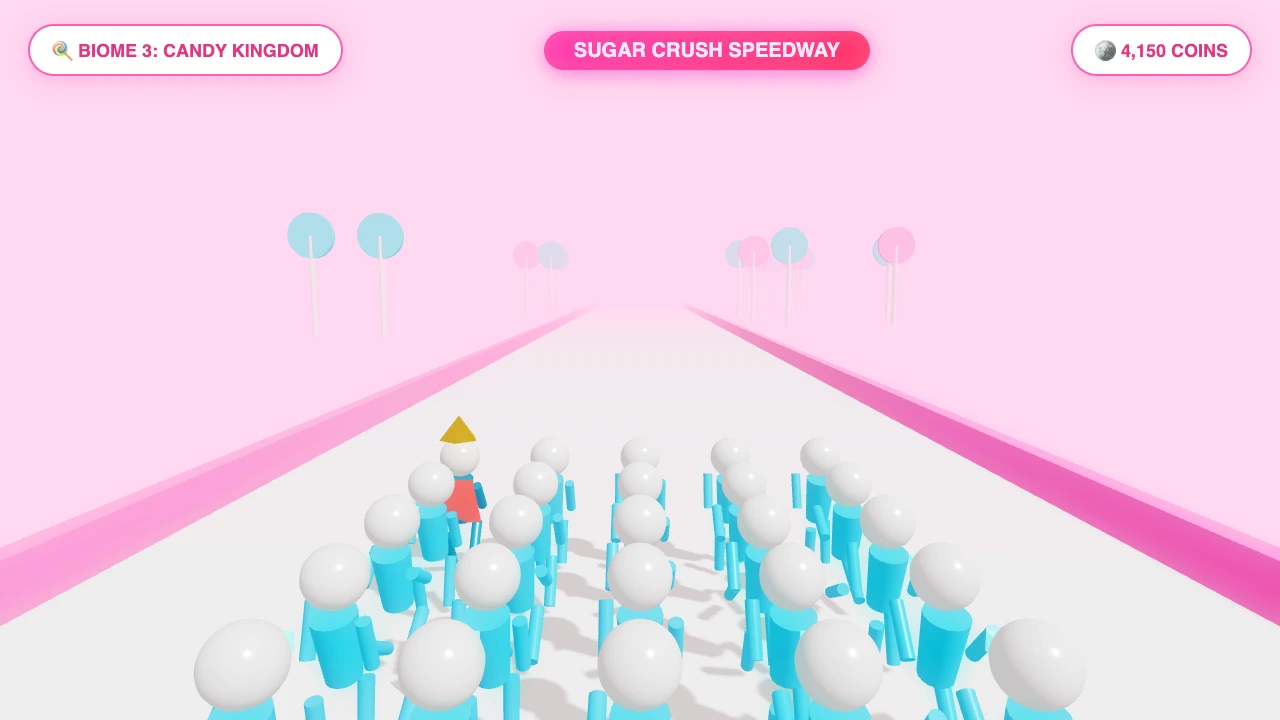
5. Biome 4: Candy Kingdom (Viscous Sugar Glaze & Pinball Bumpers)
- Friction Coefficient: $\mu = 0.95$ (Ultra-high viscous syrup grip). Lateral steering responds with extreme immediacy, but momentum decays almost instantaneously ($C_{drag} = 2.4$).
- The 'Snapping' Steering Feel: Because friction is so high, runners stick to the road like glue. Swerving feels sharp and precise, allowing players to execute razor-thin weaves between obstacles. However, trailing swarm followers snap violently into line, increasing the risk of shearing against narrow obstacle corridors.
- Kinetic Pinball Bumpers: Circular jelly gumdrop obstacles that do not destroy runners upon contact, but instead exert an instantaneous repulsive physics impulse: $\vec{J} = -k_{bounce} \hat{n}$. Hitting a bumper scatters your swarm radially across both lanes, potentially hurling runners into adjacent death pits.
- Visual Aesthetics: Bubblegum pink skies, peppermint-striped track curbs, and sparkling confectionery dust particles.
6. Biome 5: Arctic Glade (Sub-Zero Drift & Ice Slicks)
- Friction Coefficient: $\mu = 0.18$ (Polished glacial blue ice). The lowest terrestrial friction in the game.
- The Drift Mechanic: Applying a lateral steering input initiates a drift that persists long after the input is released. To cancel a leftward drift before hitting an obstacle, players must apply Counter-Steering (opposite rightward flick) to neutralize lateral momentum.
- Blizzard Visibility Impairment: Heavy procedural snowfall ($N = 600$ falling crystal particles) and rolling snow fog reduce effective visual scanning distance from $80\text{ meters}$ down to $45\text{ meters}$, cutting reaction time by nearly 40%.
- Environmental Hazards: Falling icicles that drop vertically from overhead cavern arches with only a 300ms shadow warning decal.
7. Biome 6: Cosmic Void (Zero-Gravity Inertia & Deep Space Standoff)
- Friction & Drag: $\mu = 0.05$ (Near-zero contact resistance) and $C_{drag} = 0.00$ (Vacuum physics). In the vacuum of space, once a runner begins moving laterally, they continue drifting indefinitely until a counter-force is exerted.
- Gravitational Well Traps: Miniature black hole singularities hovering alongside the track borders that exert a continuous radial gravitational pull: $F_g = \frac{G M_{hole}}{\|\vec{r}\|^2}$. Swarms passing too close to the event horizon must exert full lateral thrust to avoid being pulled into the void.
- Visual Splendor: Breathtaking backdrop of slowly rotating spiral galaxies, glowing violet nebulae, and shimmering cosmic dust clouds rendered via custom instanced star shaders.
- The Cosmic Overlord Encounter: The game's final boss, equipped with dual orbital laser beams and multi-phase cosmic shockwaves.
8. Master Biome Comparison & Environmental Matrix Table
9. Three.js GPU Optimization: Keeping Biomes at 60 FPS on Mobile
THREE.Points object:
attribute vec3 a_velocity;
attribute float a_phase;
uniform float u_time;
uniform vec3 u_wind;
void main() {
vec3 pos = position + (a_velocity + u_wind) * mod(u_time + a_phase, 10.0);
vec4 mvPosition = modelViewMatrix * vec4(pos, 1.0);
gl_PointSize = (15.0 / -mvPosition.z) * pixelRatio;
gl_Position = projectionMatrix * mvPosition;
}
Because particle updates are calculated entirely on the GPU vertex shader via simple modular arithmetic, the CPU cost is literally zero milliseconds per frame. The JavaScript main thread remains 100% free to handle high-precision 240Hz runner physics and spatial hash collision detection.
10. Dynamic Lighting & Atmospheric Fog Tuning: WebGL Shaders in Three.js
In Biome 5 (Arctic Glade), the fog density is elevated to $0.018$, with a frosty cyan tint (#a5f3fc). In Biome 3 (Magma Foundry), the density is reduced to $0.008$ with a deep volcanic orange hue (#431407) and an added noise distortion octave that simulates rising heat plumes.
Furthermore, directional sunlight in Biome 1 uses an orthographic shadow map of resolution $2048 imes 2048$, while Biome 6 (Cosmic Void) disables directional shadows entirely, relying on two dynamic point lights attached to the lead runner and the boss to cast vibrant specular highlights across the dark void.
11. Tactical Field Notes: Navigating Biome Shifts in Real Time
- Transitioning from Biome 4 (Candy Kingdom) to Biome 5 (Arctic Glade): You are moving from the highest friction in the game ($\mu = 0.95$) directly onto frictionless ice ($\mu = 0.18$). If you steer with the same forceful strokes used in Candy Kingdom, your crowd will uncontrollably spin out into the track barriers. The moment the snow particles appear, immediately halve your finger swipe amplitude and prepare to counter-steer.
- Transitioning from Biome 5 (Arctic Glade) to Biome 6 (Cosmic Void): Atmospheric drag disappears entirely ($C_{drag} = 0.00$). Any lateral motion you initiate will not stop when you lift your finger. You must actively flick in the reverse direction to arrest lateral drift.