
 PLAY NOW

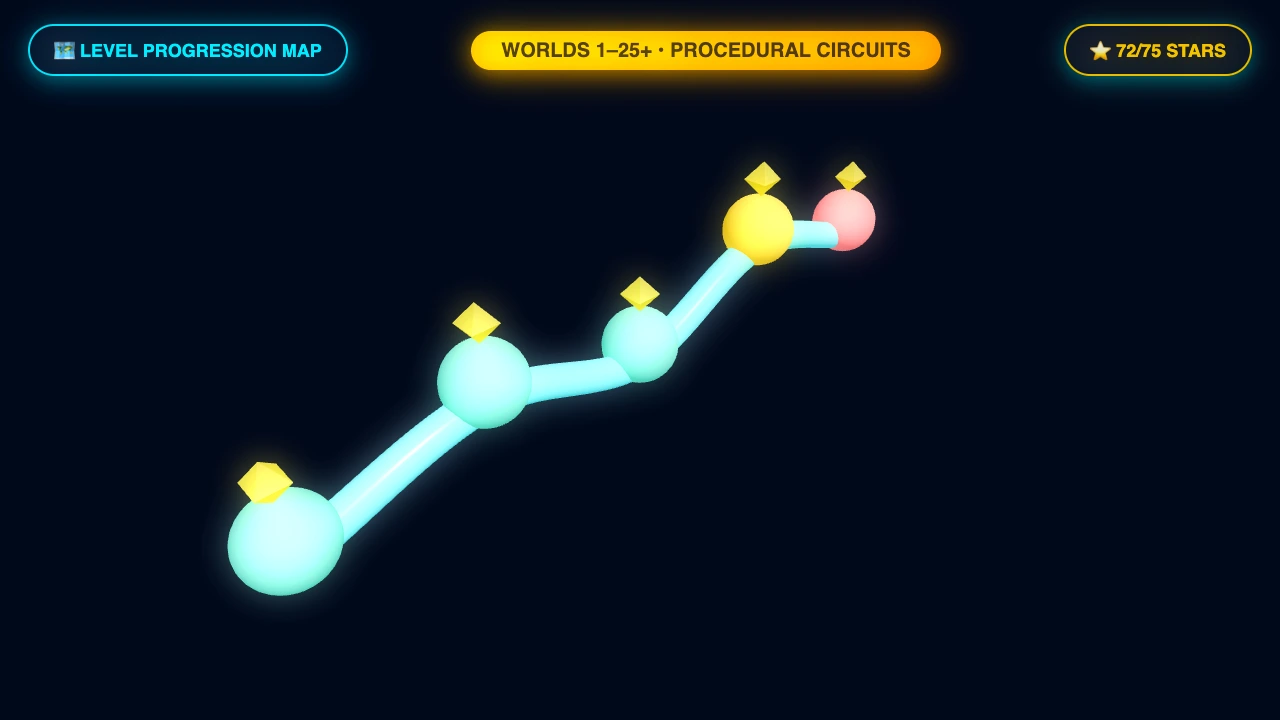
1. The Mathematics of Infinite Roadways: Procedural Generation vs Handcrafted Levels
Handcrafting hundreds of static levels in 3D modeling software like Blender is a staple of traditional console game development. However, for a lightweight HTML5 web game aimed at instant loading and endless replayability, shipping gigabytes of pre-baked 3D geometry is completely out of the question.
In Control Guys Count, our tracks are 100% procedurally synthesized on the client CPU at runtime. The entire level geometry—asphalt roadbeds, neon guardrails, holographic gate portals, swinging pendulums, spinning sawblades, and boss combat arenas—is generated through pure algorithmic mathematics from a compact, 32-bit integer seed value.
This architecture offers three monumental advantages:
- Near-Zero Network Footprint: A level does not require downloading megabytes of mesh data. The server transmits only a tiny level descriptor JSON or seed string (e.g.,
{"seed": 94827104, "biome": "neon_city"}), consuming less than 120 bytes of bandwidth. - Infinite Deterministic Replayability: Two players anywhere in the world who enter the same seed will race across the exact same sequence of math gates, hazard timings, and boss encounters down to the sub-millimeter.
- Adaptive Dynamic Difficulty: The track generator can continuously adjust obstacle spacing, gate multipliers, and hazard velocities based on live player performance metrics.
2. Deterministic Pseudo-Random Number Generation (PRNG)
Standard JavaScript provides
Math.random(), but Math.random() is an unseeded PRNG whose implementation varies between browsers (e.g., V8 uses xorshift128+, while Safari uses a different algorithm). If you use Math.random(), you cannot reproduce identical tracks across different devices, destroying tournament speedrunning integrity.
To ensure strict cross-browser determinism, Control Guys Count incorporates a custom Linear Congruential Generator (LCG) with carefully selected mathematical constants:
// Deterministic Seeded PRNG Implementation
class TrackPRNG {
constructor(seed) {
this.m = 0x80000000; // 2^31
this.a = 1103515245;
this.c = 12345;
this.state = seed ? (seed & 0x7fffffff) : Math.floor(Math.random() * (this.m - 1));
}
nextFloat() {
this.state = (this.a * this.state + this.c) % this.m;
return this.state / (this.m - 1);
}
range(min, max) {
return min + this.nextFloat() * (max - min);
}
}
Every random decision during track construction—whether a segment spawns a pendulum, a double gate, or an enemy crowd roadblock—pulls strictly from this generator. A seed of class TrackPRNG {
constructor(seed) {
this.m = 0x80000000; // 2^31
this.a = 1103515245;
this.c = 12345;
this.state = seed ? (seed & 0x7fffffff) : Math.floor(Math.random() * (this.m - 1));
}
nextFloat() {
this.state = (this.a * this.state + this.c) % this.m;
return this.state / (this.m - 1);
}
range(min, max) {
return min + this.nextFloat() * (max - min);
}
}
42 produces the exact same track whether executed in Chrome on macOS or Safari on iOS.
3. The Musicality of Level Design: Rhythm, Beat, and Rest Waves
Great game design mirrors great music. If a track bombards the player with relentless, uninterrupted high-intensity hazards, the player rapidly experiences sensory exhaustion and mental burnout. Conversely, if a track is too empty, boredom sets in.
To maintain perfect engagement, our procedural track generator structures levels using Pacing Wave Harmonics:
- The Tension Phase (Beat): A 60-unit track sequence featuring dense hazard clusters (e.g., interlocking spinning saws and swinging axes) that force tight swarm compression and evasive micro-strafing.
- The Resolution Phase (Rest): An open 40-unit straightaway containing only positive math gates and sparkling gold coin arcs, allowing the player to relax, survey their expanded crowd, and prepare for the next challenge.
- The Climax Phase (Crescendo): A high-stakes dual gate immediately followed by an enemy swarm roadblock or the arena gateway to a colossal Titan Boss.
4. Chunk-Based World Streaming & Memory Pool Recycling
A major pitfall in endless runner engineering is memory leakage caused by instantiating new road meshes as the player progresses and forgetting to deallocate discarded segments behind them. Over time, browser memory consumption balloons until the tab crashes.
In Control Guys Count, the game world is segmented into standardized Track Chunks (each precisely 50 units long). The engine maintains an active pool of exactly 8 Track Chunks:
- As the swarm crosses into Chunk \(K\), Chunk \(K-2\) (now positioned safely behind the camera view) is detached from the scene.
- Rather than deleting the Three.js mesh, the chunk is recycled: its world position is translated ahead to \(K+6\), its procedural parameters are re-rolled via the PRNG, and its child obstacle meshes are repositioned.
5. Track Difficulty Parameter Scaling Across Campaign Milestones
Our track generation algorithm dynamically adjusts its spawning parameters based on the player's campaign progress. Review the mathematical parameter progression matrix across key milestones:
This graduated difficulty curve ensures that novice players build foundational motor memory while seasoned veterans encounter relentless tactical gauntlets on later campaign stages.
| Campaign Milestone | Track Speed | Hazard Density | Negative Gate Probability | Boss Health Pool |
|---|---|---|---|---|
| Level 1 (Novice Tutorial) | 22.0 units/sec | 1 hazard per 80 units | 0.00 (100% positive gates) | 150 HP (Stone Golem) |
| Level 5 (Apprentice) | 25.5 units/sec | 1 hazard per 55 units | 0.25 (1 in 4 gates negative) | 450 HP (Mecha Golem) |
| Level 12 (Biome 4: Candy Kingdom) | 29.0 units/sec | 1 hazard per 40 units | 0.40 (Tight lane divides) | 900 HP (Gummy Behemoth) |
| Level 25 (Expert Gauntlet) | 33.5 units/sec | 1 hazard per 28 units | 0.55 (Compound division traps) | 1,850 HP (Cosmic Destroyer) |
| Level 50+ (Master Apex) | 38.0 units/sec | 1 hazard per 20 units | 0.65 (Maximum micro-strafing) | 3,600 HP (Cosmic Overlord) |
6. Seamless Chunk Stitching: Eliminating Visual and Physics Seams
In modular 3D track synthesis, positioning contiguous road chunks can easily introduce minute floating-point rounding errors. If Chunk A terminates at Z = 150.0001 and Chunk B begins at Z = 150.0003, a microscopic 0.0002-unit gap appears. At high running speeds, this gap produces an unsightly light seam or causes player ground raycasts to miss, causing runners to falsely register as falling off the track.
To enforce flawless continuity, Control Guys Count utilizes an Integer Grid Snapping and Vertex Overlap Pipeline:
- Discrete World Quantization: All chunk attachment anchors are strictly quantized to 64-bit integer grid units before being converted to floating-point Three.js world matrices.
- Overlapping Skirt Vertices: The trailing edge of each asphalt road chunk includes a 0.2-unit downward-angled 'skirt' that nests underneath the leading edge of the subsequent chunk, physically concealing any sub-pixel GPU rasterization seams.
7. Harmonic Hazard Formulations: Calculating Angular Velocities
The placement of kinetic obstacles is governed by precise harmonic oscillation physics. A pendulum blade cannot swing at arbitrary frequencies; its period must harmonize with the player's forward running velocity.
Let \(V_{ ext{run}}\) represent track forward speed, and let \(W_{ ext{corridor}}\) represent the width of the safe corridor:
heta(t) = heta_{\max} \cdot \sin(\omega t + \phi) \ T = rac{2\pi}{\omega} \implies ext{Spatial Wavelength } \lambda = V_{ ext{run}} \cdot T
Our procedural track compiler calculates \(\omega\) such that the safe passage window remains open for a minimum of 320 milliseconds when the center of mass of the crowd crosses the blade's sweep plane. This rigorous kinematic formulation ensures that avoiding damage is always a question of player skill and timing, never impossible mathematical bad luck.8. Ensuring Mathematical Solvability: The Fairness Guardrail Engine
Procedural generation must never generate an impossible scenario. Nothing alienates a player faster than encountering an unavoidable wall of spikes or a pair of division gates that obliterates their entire crowd with zero counterplay.
Our track compiler runs a continuous Forward Lookahead Simulation:
orall ext{ GatePair } G_k, \quad \max( ext{Yield}(G_{k,A}), ext{Yield}(G_{k,B})) \ge ext{TargetThreshold}_k
If a procedurally generated segment fails this invariant check during track compilation, the segment is automatically rejected, its PRNG seed is re-hashed with an invariant salt, and a guaranteed-solvable segment is generated in its place. The result is pure, uncompromised competitive fairness.9. Dynamic Difficulty Adjustment (DDA): Adaptive Attrition Compensation
While game purists often debate the merits of rubber-banding, in high-velocity crowd runners, complete absence of dynamic adaptation can create a 'death spiral.' If an unlucky player loses 85% of their swarm on Level 3, proceeding into the Level 3 Boss with only 4 surviving stickmen makes defeat mathematically inevitable, forcing an unrewarding, drawn-out loss.
In Control Guys Count, we developed a sophisticated Non-Invasive Dynamic Difficulty Adjustment (DDA) algorithm:
- The Crisis Detector: If a player's crowd headcount drops below \(N_{ ext{critical}} = 8\) within 50 units of a boss arena, the generator dynamically alters the final gate pairing immediately preceding the arena entrance.
- Emergency Multiplier Rescue: The gate values are algorithmically re-weighted to inject an emergency +35 or ×4 bonus into the safer lane.
- Invisible Execution: To preserve player agency and pride, this adjustment is entirely invisible: gate visual styling and sound effects remain identical. The player feels the intense thrill of a heroic last-second recovery!
10. Automated CI/CD Monte Carlo Verification: Testing 10,000 Seeds Overnight
How does a game studio guarantee that an infinite procedural generator never creates a game-breaking glitch or impossible track layout across millions of potential seeds?
Our development pipeline includes an automated Headless Monte Carlo Test Suite executed in Node.js with headless WebGL bindings:
// Automated Headless Monte Carlo Simulation Runner
async function runMonteCarloSeedAudit(seedBatchSize = 10000) {
console.log(`Starting automated audit of ${seedBatchSize} procedural seeds...`);
let impossibleSeeds = 0;
for (let seed = 0; seed < seedBatchSize; seed++) {
const track = compileProceduralTrack(seed);
const bot = new SyntheticOptimalAgent(track);
const outcome = bot.simulateRun();
if (!outcome.reachedBoss || outcome.finalCrowd < 1) {
console.error(`FATAL: Seed #${seed} failed solvability test!`);
impossibleSeeds++;
}
}
console.log(`Audit complete. Solvability Rate: ${(1 - impossibleSeeds/seedBatchSize)*100}%`);
}
Every code commit to our track generator must pass this 10,000-seed audit with a 100.00% solvability rating before deploying to production. This rigorous software engineering practice guarantees that players never encounter broken levels, securing Control Guys Count's reputation as the most polished web runner on the internet.
Furthermore, for verified speedrunning tournaments and global leaderboards, each procedural seed is hashed with a cryptographic SHA-256 telemetry seal. When a player submits a speedrun recording, the client transmits the input timestamp delta stream and the seed hash. The server replays the inputs deterministically through the exact same LCG generator to verify that no memory injection or track alteration cheats were utilized. This guarantees that all world records featured in our Hall of Fame represent genuine human achievement.
async function runMonteCarloSeedAudit(seedBatchSize = 10000) {
console.log(`Starting automated audit of ${seedBatchSize} procedural seeds...`);
let impossibleSeeds = 0;
for (let seed = 0; seed < seedBatchSize; seed++) {
const track = compileProceduralTrack(seed);
const bot = new SyntheticOptimalAgent(track);
const outcome = bot.simulateRun();
if (!outcome.reachedBoss || outcome.finalCrowd < 1) {
console.error(`FATAL: Seed #${seed} failed solvability test!`);
impossibleSeeds++;
}
}
console.log(`Audit complete. Solvability Rate: ${(1 - impossibleSeeds/seedBatchSize)*100}%`);
}

Figure 4.1: Procedural Kinetic Hazard Placement Geometry: Spacing, Angular Harmonic Frequencies, and Clearance Corridors.