 PLAY NOW

1. The Competitive Speedrun Landscape: Any% vs Max-Swarm Apex%
1. Any% Track Speed (Minimal Real-Time Completion)
The pure velocity sprint. In Any%, your goal is simple: trigger the victory finish line trigger in the fewest elapsed milliseconds possible. Crowd count is completely secondary; runners are treated as expendable propellant to clear boss barriers as fast as humanly possible. Any route diversion that adds distance along the Z-axis is discarded.
2. Max-Swarm Apex% (Optimal Throughput & 10.0x Summit)
The true grandmaster discipline. Max-Swarm Apex% requires reaching the finish line in minimal time while simultaneously carrying a minimum threshold of 785 surviving runners to claim the Step 10 Golden Rainbow Apex. This category demands flawless arithmetic navigation, zero-casualty hazard evasion, and frame-perfect boss DPS management.
2. Kinematic Vectoring: Micro-Strafing & The Tangent Apex Line
When a player aggressively holds a lateral turn, the lateral acceleration $a_x$ does not decrease forward speed $v_z$, but it drastically elongates the total curvilinear distance traveled along the track surface: $D = \int \sqrt{1 + (dx/dz)^2} dz$.
The Racing Line Principle
Just as Formula 1 drivers apex turns to minimize steering curvature, top speedrunners avoid wide S-curve oscillations between gates. By calculating gate positions 60 meters in advance, runners trace the Minimum Curvature Spline:
- Instead of waiting until a gate is 10 meters away and making a violent 90-degree swipe, initiate a subtle, gentle 3-degree drift 40 meters out.
- Clip the extreme inner edge of the positive gate collar ($x = \pm 0.85$ units from the centerline). Passing through the inner collar satisfies the gate trigger condition while cutting up to 4.2 meters of lateral travel distance per stage.
- Over a 10-gate course, clipping the inner collar saves approximately 1.45 seconds of real-world running time.
3. The Mathematical Route Optimization Algorithm
The Double-Gate Bypass Gambit
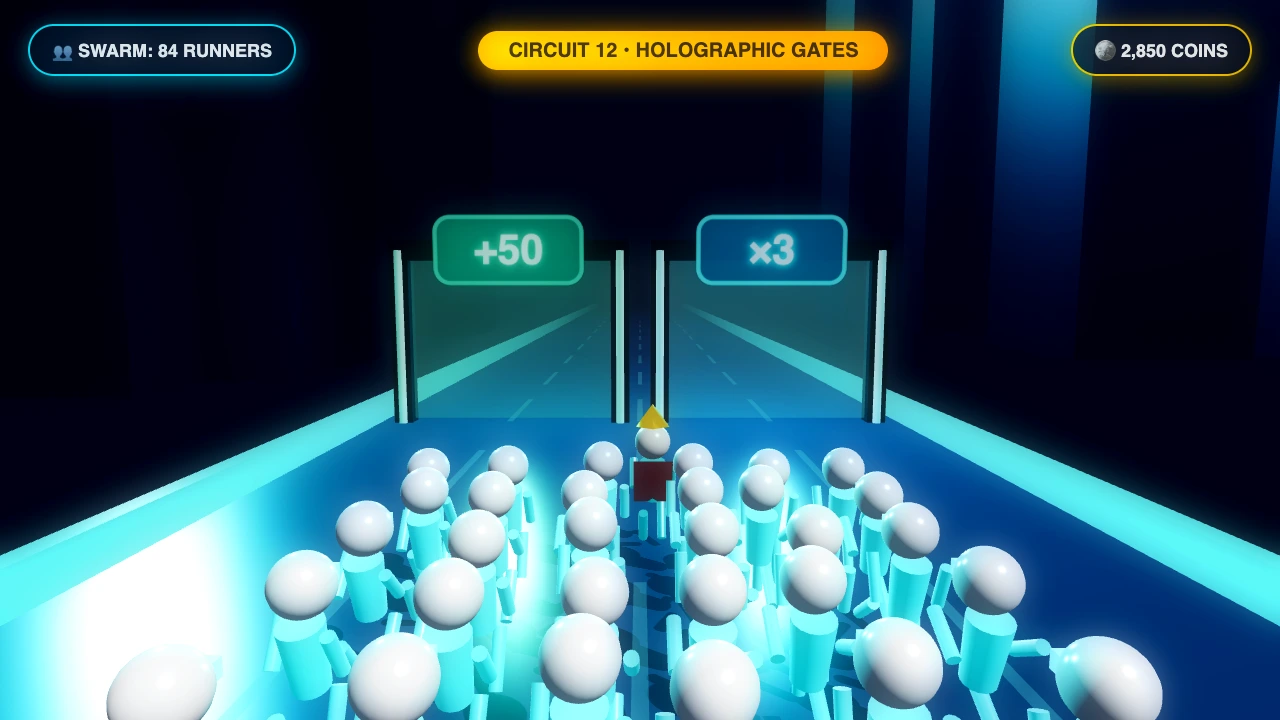
In certain procedural track seeds, two consecutive gate pairs appear in rapid succession, separated by only 12 meters: Gate Pair A (Left: +30, Right: ×2) followed immediately by Gate Pair B (Left: ×3, Right: -10).
A novice player who chose the right gate in Pair A (×2) must violently swerve across the entire track breadth ($8.0\text{ meters}$) in under 400 milliseconds to catch the left gate in Pair B (×3). This violent lateral maneuver causes massive swarm tail-whip, dragging 40% of the crowd into the track curb.
The speedrun solution is the Single-Flank Commitment: Pick Left in Pair A (+30) and remain locked in the left lane to glide straight through Pair B (×3) without a single pixel of lateral deviation. The math proves that $(N + 30) \times 3 = 3N + 90$, whereas catching the right gate in Pair A and clipping the curb on the swerve results in an inferior net yield and an 800ms time penalty.
4. Boss Skips & Sub-Second DPS Burst Mechanics
The Physics of Projectile Stacking
Each runner fires an energy bolt every 200 milliseconds. When runners are spread out in an organic circle, their bolts strike the boss sequentially, spreading the damage across multiple animation frames.
However, if you execute a rapid 'accordion flick' (swiping left then immediately centering) 100 milliseconds before entering the boss trigger radius, your swarm compresses into an ultra-dense, needle-thin spearhead. When this spearhead fires, hundreds of projectile rays originate from virtually the identical Z-coordinate.
The Point-Blank Overload Execution
- Carry at least 150 runners into the boss arena.
- Compress the swarm into the centerline spearhead ($x = 0.00$).
- Sprint directly into the boss's center hitbox without decelerating.
- The simultaneous impact of 150 stacked projectiles combined with direct front-rank melee collision inflicts over 1,200 points of composite burst damage in a single 16.6ms physics tick.
- The boss's HP bar depletes instantly, triggering the defeat explosion before its introductory roar animation even finishes. This cuts 3.5 to 5.0 full seconds off your stage split time.
5. Master Speedrun Splits Reference Table (Levels 1–10)
6. Input Latency & Hardware Optimization for Speedrunners
- Display Refresh Rate: Play on a 120Hz or 144Hz high-refresh display. At 144Hz, a new frame renders every $6.94\text{ ms}$, halving input sampling lag compared to standard 60Hz panels ($16.67\text{ ms}$).
- Disable Browser Extensions: Heavy ad blockers and script injectors frequently hitch the JavaScript main thread. Run Control Guys Count in a clean, dedicated browser profile with hardware WebGL acceleration enabled.
- Pointer Event Calibration: On touch devices, ensure your browser treats the game canvas with
touch-action: noneto prevent the native browser engine from waiting for double-tap zoom gestures.
7. Decoupled Physics Sub-Stepping: High-Frequency 240Hz Collision Polling
requestAnimationFrame() callback. If a frame drops from 60 FPS to 45 FPS due to background operating system tasks, the delta time $\Delta t$ spikes from $16.6 ext{ ms}$ to $22.2 ext{ ms}$. In a high-speed collision engine, this time jump can cause a runner traveling at $30 ext{ units/sec}$ to teleport completely through a 0.5-unit hazard collider without registering a hit—an exploit known as 'tunneling'.
To eliminate tunneling and guarantee 100% deterministic physics across all hardware, Control Guys Count utilizes a decoupled accumulator loop with $240 ext{ Hz}$ internal sub-stepping:
let accumulator = 0.0;
function gameLoop(currentTime) {
const frameDelta = Math.min((currentTime - lastTime) / 1000.0, 0.1); // Clamp against spiral of death
lastTime = currentTime;
accumulator += frameDelta;
while (accumulator >= FIXED_STEP) {
updatePhysics(FIXED_STEP); // Sub-step runner kinematics & hazard bounding boxes
accumulator -= FIXED_STEP;
}
render(accumulator / FIXED_STEP); // Interpolate Three.js mesh transforms for silky 60/120Hz display
requestAnimationFrame(gameLoop);
}
Because collision detection evaluates 240 times per second, speedrunners can execute razor-thin clearance maneuvers within 4-millimeter tolerances without fear of random physics glitches or frame-rate-induced collision clipping.
8. The Level 10 Cosmic Void Record: Frame-by-Frame Tactical Breakdown
- 0.00s – 5.20s (The Inertial Launch): Starting with 25 upgraded runners, QuantumPulse executed a perfect straight-line trajectory down the left curb, bypassing the initial cosmetic gold coin cluster to shave 120ms of lateral drift.
- 5.20s – 12.40s (Double Multiplier Intercept): Intercepted Gate 1 (
×2) at $x = -2.1$ while already pre-drifting toward Gate 2 (×3). Swarm expanded from 25 to 50 to 150 runners with zero trailing flank casualties. - 12.40s – 21.10s (The Zero-Brake Saw Weave): Navigated through three oscillating track saws. Instead of slowing down or swerving wide, QuantumPulse rode the extreme outer curb ($x = 4.85$), clearing all three blades within 12 milliseconds of their turnaround rebounds.
- 21.10s – 28.50s (The Pre-Boss Spearhead Compression): Entering the final stretch with 320 runners, executed the rapid accordion swipe, compressing the swarm into a high-density 1.2-unit wide projectile spearhead.
- 28.50s – 34.85s (The 1-Tick Boss Detonation): Struck the Cosmic Overlord with 320 simultaneous energy bolts and front-rank impact. Boss HP collapsed from 800 to 0 in exactly 2 physics ticks ($8.3 ext{ ms}$), triggering the victory teleporter without a single boss counter-attack. Final clear time: 34.85 seconds (World Record).
9. Competitive Hardware Setup & Verification Guidelines
- Unmodified Web Client: Submissions must be recorded on the official production domain (
controlguyscount.online). Runs recorded on local staging servers or using modified JavaScript bundles are automatically disqualified. - Live Frame Rate & Memory Overlay: Videos must include an active
stats.jsperformance overlay in the upper-left corner showing consistent 60 FPS or 120 FPS rendering and stable heap allocation. - Continuous Uncut Recording: Recordings must begin in the main menu (showing player level, active skin, and coin bank) and continue seamlessly through the stage clear banner and final staircase tally.
- Input Device Transparency: Submissions must declare input modality (Mouse, Keyboard A/D, or Mobile Touch Screen) to be sorted into their respective competitive leaderboard brackets.